Warranty
infrastructure
you build on.
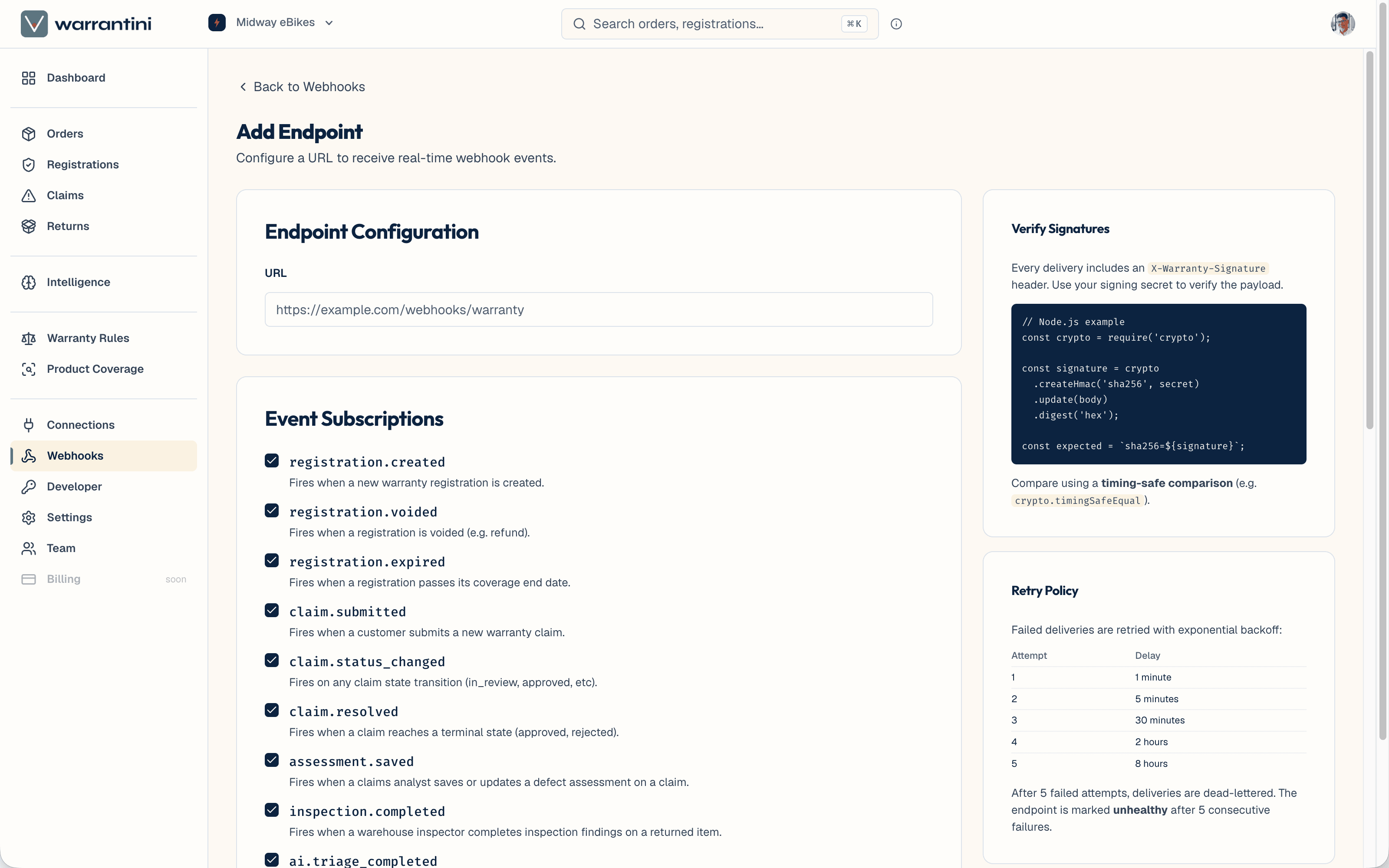
A versioned REST contract, an MCP server with 19 tools, signed webhooks on 13 events, separated test and live keys, and a sandbox on a real database branch. One contract, three projections. Our own customer portal runs on the public API. We eat it before you do.
# One claim, filed by whatever you already run
curl -X POST https://api.warrantini.com/v1/claims \
  -H "Authorization: Bearer wrnt_live_..." \
  -H "Idempotency-Key: 8f14e45f-ea2f" \
  -d '{
    "registration_id": "reg_2m7bx1",
    "issue_type":      "defect",
    "description":     "Zip separated at the base"
  }'

# → 201 Created
{ "id": "clm_7t3nw2",
  "status": "submitted",
  "coverage": { "in_window": true,
                "rule_id": "rul_24mo_hardgoods" } }

# Replay it. Same key, same response —
# not a second claim.
The contract, in full.
Everything the dashboard does, over the API.
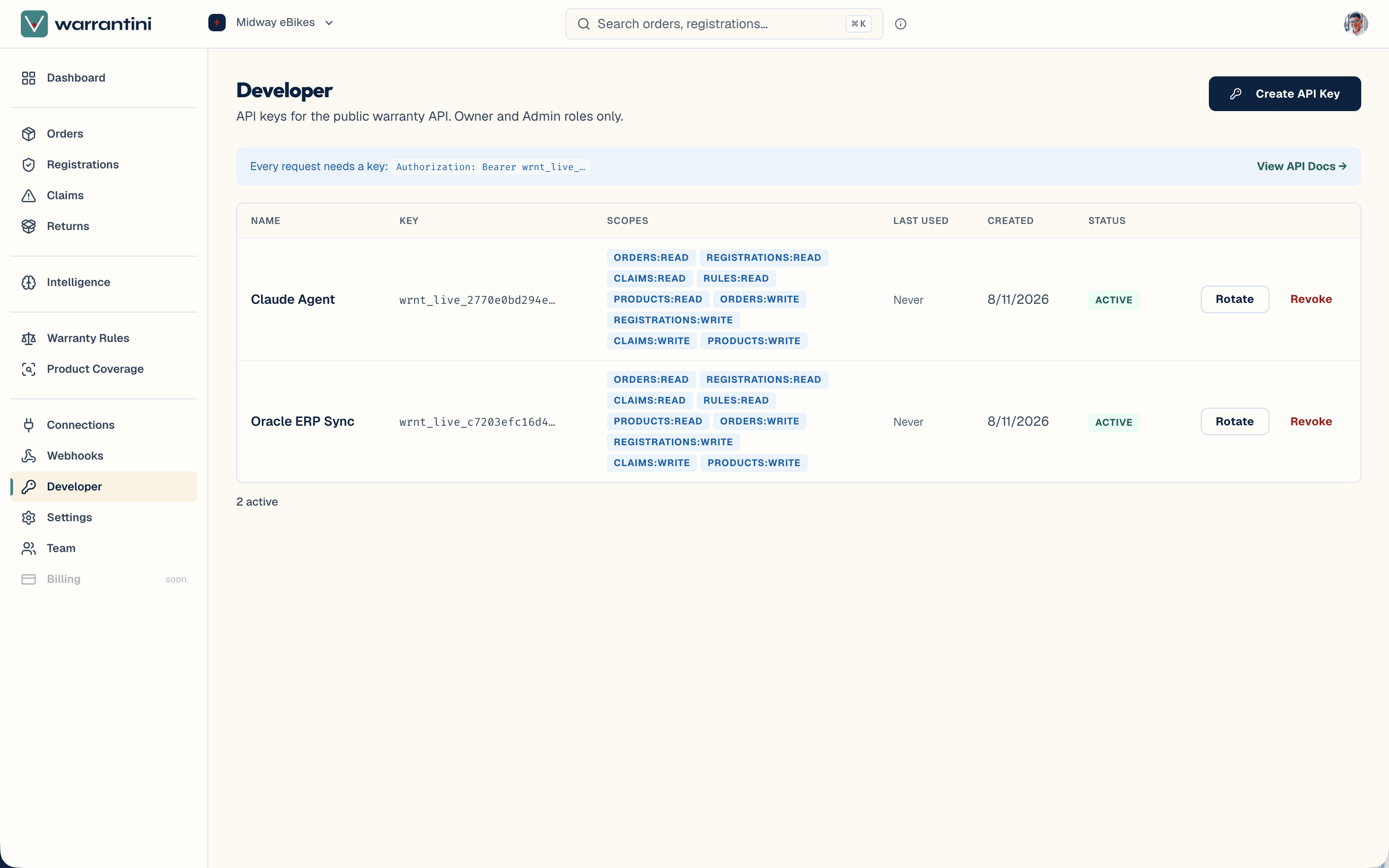
API keys with scopes
Nine scopes across orders, products, registrations, claims, and rules. Test and live keys are distinct and can’t cross. The environment is baked into the key itself (wrnt_test_… / wrnt_live_…), fixed at creation.
Idempotency keys on every write
Replay a batch, get the original response. Not a duplicate. Built for the retry logic real integrations actually have.
RFC 7807 problem details
Stable error types, so your handling isn’t string-matching our prose.
Cursor pagination
Consistent across every list endpoint.
OpenAPI generated from the route definitions
Not written by hand, so it can’t drift from the implementation. There is no published SDK yet. Generate a client in your language from the spec. That’s what you were going to do anyway.
A real sandbox, not a flag
Sandbox mode provisions an actual isolated database branch with seeded orders, products, registrations, and rules. Break things against realistic data; reset it whenever you want.
A deprecation commitment in writing
No breaking changes within v1. If a version is superseded, both serve concurrently for at least 90 days, with Deprecation and Sunset headers and an email to every key owner.
Warranty your agents can drive —
and you can just ask.
19 tools across orders, products, registrations, claims, and rules, over the same resource model, scopes, and tier gating as the REST API. Connect Claude, ChatGPT, or Microsoft Copilot over OAuth 2.1. No keys in a script. Then it works two ways: an agent transacts against it on a schedule, or you open the chat window you already use and ask.
Gartner projects agentic AI resolving 80% of common customer service issues autonomously by 2029. Warranty is the part of that with a coverage rule behind it.
The last one is the tell. Your warranty data is in the same conversation as the file you just dropped in. No dashboard can do that at any price.