Your store runs on software. Your warranty runs on somebody’s memory.
Connect your store, write your coverage rules, and publish a portal in your own brand. Claims arrive already triaged, move through your team on one record, and leave behind data about which products actually fail. The software side takes an afternoon, and we help you with the rest.
Nobody decided to run warranty out of an inbox.
It just happened. A form on the site collects registrations into a spreadsheet somebody owns. Claims arrive in the same inbox as “where is my order”, get a personal reply, and are never counted. Coverage gets checked by scrolling back through emails, and when it can’t be checked it gets approved anyway, because arguing with a customer over a receipt costs more than the replacement. None of that is carelessness. There was never a system to put it in.
Peak makes it worse.
The month you have the most claims is the month you have the least attention to give them.
Nobody can answer “how long does a claim take?”
Not that it takes too long. Nobody ever measured.
The pattern is in there.
Which SKU, which batch, which failure. It is sitting in the inbox, unreadable.
Connect the store, write the rules, send the link.
Connect.
Shopify, BigCommerce, or whatever you sell on — authorized once. Orders and products sync on their own, and historical orders come with them, so coverage resolves against sales you already made. The connectors are free, and so is help getting it running.
Set coverage.
Your policy as rules — match on SKU, product type, category, or vendor. The preview shows which products are covered, which are excluded, and which fall through a gap, so you find the gap before a customer does.
Share the link.
In the post-purchase email, on your support page, in the box. Customers register and file claims themselves, on a portal in your brand.
That’s the portal live. Your policies, your team’s workflow, and anything you want it wired into come after — and we help with those too.
- Shopify
- Amazon Selling Partner
- BigCommerce
- WooCommerce
- Adobe Commerce


One record, however many people touch it.
The customer’s messages, the photos they sent, the coverage decision and who made it, the replacement that shipped, and what the warehouse found when it arrived — all on the claim, in one timeline. Nobody forwards a thread to catch someone up, and nobody answers a customer twice with two different stories.
A warranty claim is the least fun email your customer will ever send you.
It is also one of the few moments they are paying complete attention. The portal they land on carries your brand, not ours — and it answers the question they actually have, which is not “has this been received” but “am I covered, and what happens now.” They can see it themselves, at 11pm, without waiting for a reply.
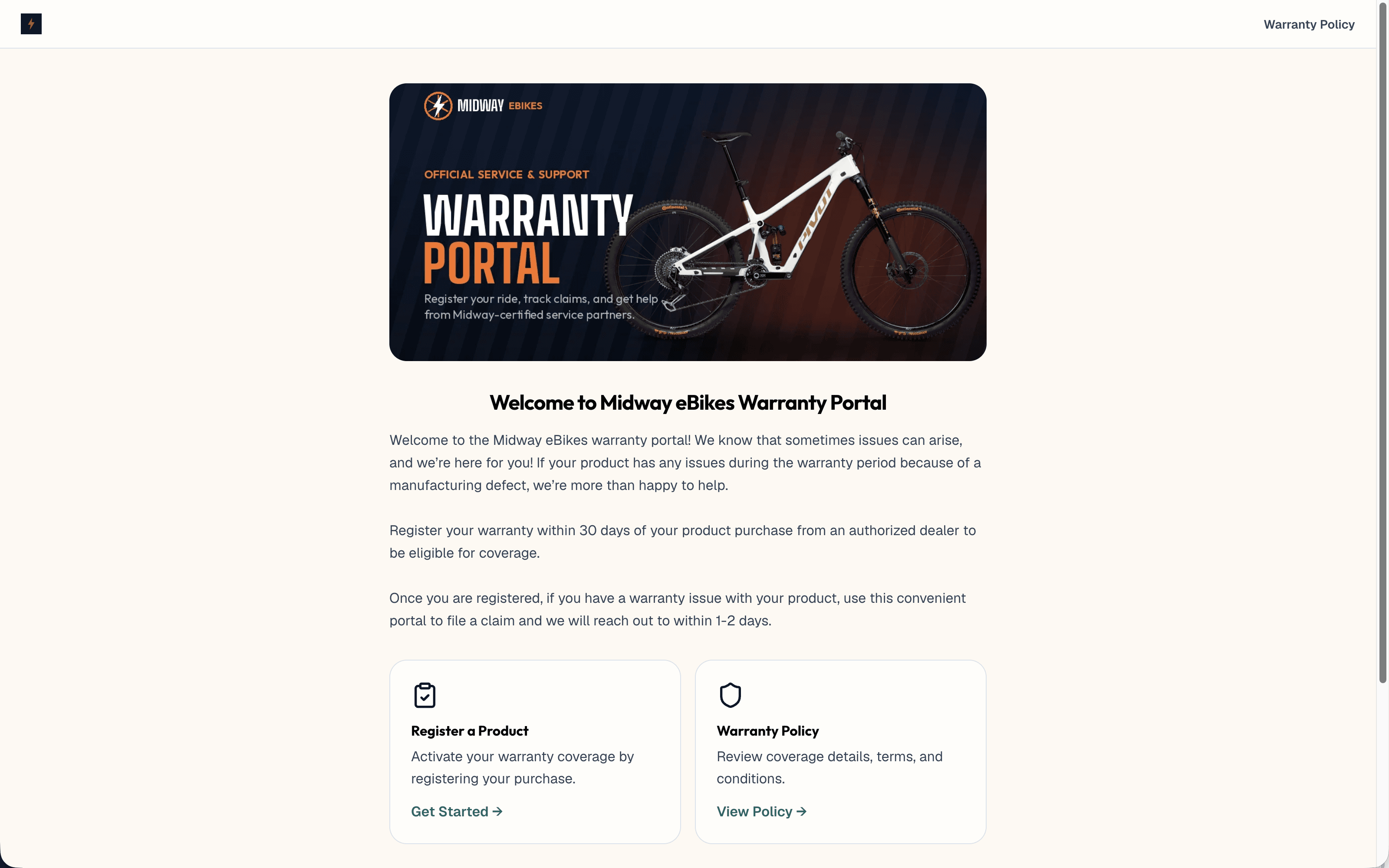
Six months in, you know which product is the problem.
Every claim arrives structured — defect category, affected area, how it was used — because the workflow captured it rather than asking someone to remember. That turns a year of claims into an answer about your own products, which is the thing a spreadsheet of registrations could never give you.
“We already have a warranty page.”
A page collects intent. This creates a record — a coverage window, the rule that produced it, and a claim that can move through your team without anyone re-reading the thread.
“We use Zendesk or Gorgias for this today.”
Support desks are built for tickets, not warranty state: coverage terms, expiry dates, serial numbers, defect categories, and what the warehouse found. A ticket closes. A warranty runs for years.
Try it against last quarter’s claims.
14 days free, cancel any time. No implementation fee. Point it at last quarter — the claims you remember, and the one you approved because checking was too expensive. You already know the right answers. See whether it does.