
AI claims triage should classify every warranty claim on arrival, check it against coverage, flag what looks wrong, and route it with a recommendation. It should not deny a claim on its own, and it should not approve one unless you have switched that on and set the bar yourself. That line, between analysis and decision, is what makes automated warranty claim processing safe to run.
Most pitches in this category go the other way. The promise is claims that resolve themselves, or a chatbot that answers customers in under a minute. That solves a queue problem. It doesn’t solve a warranty problem, because the hard part of a claim is judgment. Is this a defect or misuse? Is it covered? Repair or replace? Is it the fourth one this month on the same product line?
Every claim is classified when it arrives: how complex it is, how likely it is to be valid, and whether anything about it is unusual. Then it is routed, with a recommendation attached.
That much should always happen. It costs your team nothing and it means no claim sits unopened because nobody knew whose it was.
These are checks and sorting. They are the parts a person does badly because they are tedious, and the parts where a wrong answer is cheap to correct.
- Check coverage. Is the product covered, and is the claim inside the term that applied on the day it was bought?
- Check completeness. Is anything missing that the team will need, such as a photo, a serial number, or a description of the fault?
- Flag anomalies. A second claim on the same item, a claim filed days before the window closes, a pattern that doesn’t fit.
- Route it. To the right person or queue, with the reasoning attached.
These are the calls where being wrong costs a customer or a lot of money.
- Every denial. A rejected claim is a customer you might lose. A person should own that decision and the reason given for it.
- High-value approvals. A full replacement on an expensive product deserves a look.
- Anything ambiguous. Defect or misuse, wear or failure. These are judgment calls, and they’re the reason you have a team.
| AI does this | A person decides this |
|---|---|
| Classifies the claim on arrival | Whether to deny it |
| Checks coverage and the term | High-value approvals |
| Flags duplicates and odd timing | Defect or misuse, when unclear |
| Pre-fills the defect assessment | Whether to accept the assessment |
| Recommends a resolution | Which resolution to give |
| Routes and escalates | Whether to turn on auto-approval |
Three numbers tell you whether triage is working.
Time to first action. How long a claim waits before someone does something with it. Triage should push this toward zero, because every claim arrives already sorted.
Override rate. How often your team changes what the AI recommended. A falling rate means it’s learning your products and your judgment. A rate that never moves means the recommendations aren’t useful.
Escalations caught early. Claims that needed a supervisor and got one before the clock ran out.
This is where analysis earns its place, and where honesty matters most. Manual, rule-based review catches 15–25% of warranty fraud. AI-assisted review catches 60–75%. That’s a large improvement. It is not elimination, and anyone quoting 99% is selling you a number they invented.
The bigger lever is prevention. Most of what gets called fraud is duplicate claims, sliding coverage dates, and claims on products nobody bought. Those stop at the database, before triage ever sees them. We covered that in the warranty fraud you’re not catching.
Six AI decision points sit inside the claims workflow, and they are sorted by what they’re allowed to do.
Four only ever suggest. Assessment intelligence pre-fills the defect category, affected area, and usage context, each with a confidence figure, and can only choose from options you configured. Resolution recommendation proposes repair, replace part, replace full, or refund, with a one-sentence rationale and up to five of your own comparable past claims. Rule recommendations review 90 days of claims against your coverage rules and suggest adjustments. Defect pattern detection watches for clusters and rate spikes, and changes nothing.
One acts only if you turn it on. Claims triage always classifies and routes. Auto-approving or auto-rejecting ships off. You enable it, and you set the confidence threshold it has to clear. Most teams run it as routing and never turn the rest on, which is a perfectly good outcome.
One acts inside a workflow you already have. Escalation intelligence decides when a claim needs a supervisor, earlier for a safety signal or a high-value product. The time-based thresholds stay underneath as a backstop.
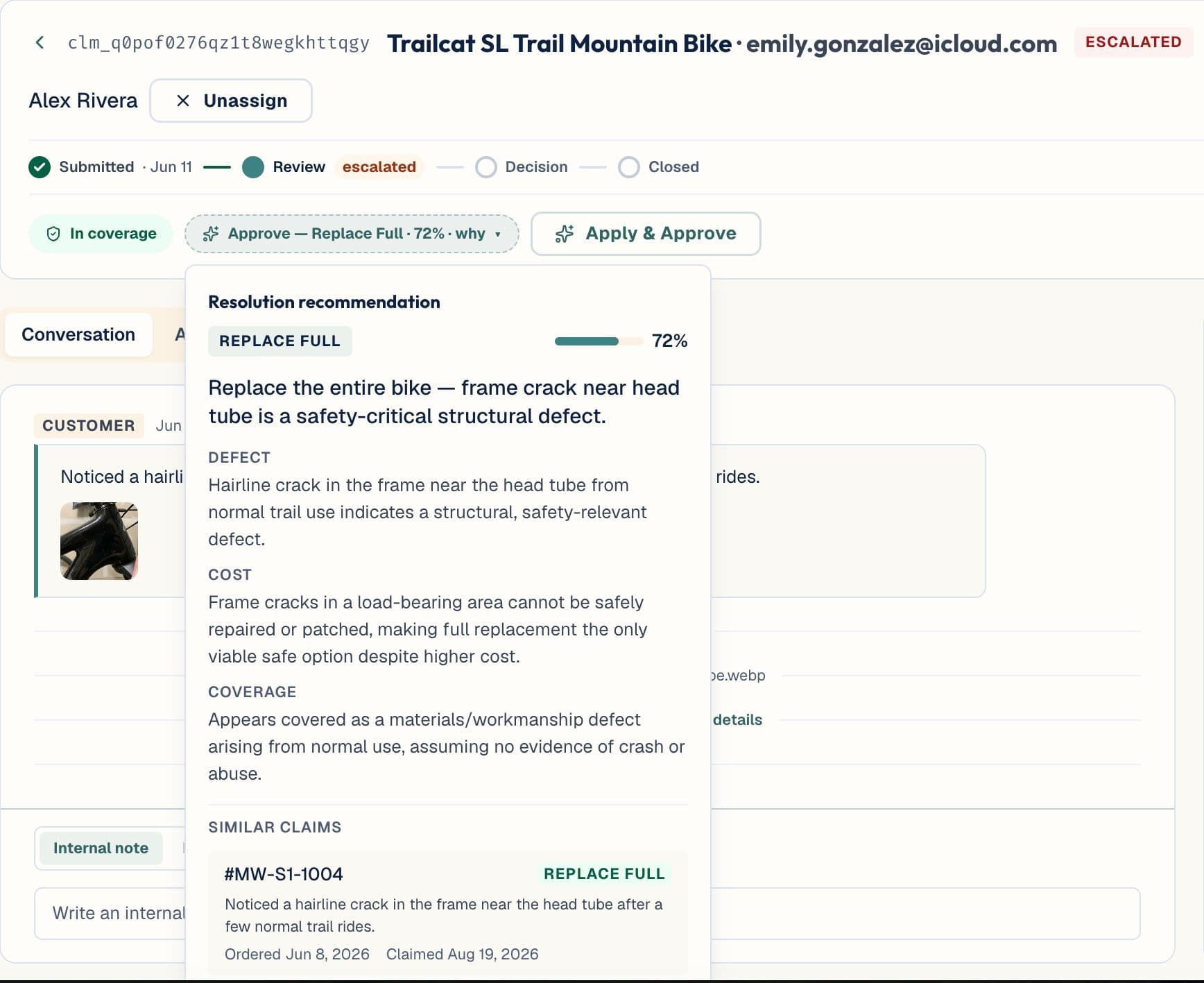

Every decision is recorded with its inputs, reasoning, confidence, and model. When your team overrules a recommendation, that outcome is appended to the record, and it becomes the training signal. If the model is unavailable, the manual workflow runs exactly as before. Claim submission never waits on it.
The AI works from the claim, the customer’s description, and your product and claim history. It doesn’t replace the person who looks at the photos and decides. On a claim where the evidence is the picture, your team is doing the work, and it should be.
It can, if you let it. In warrantini, auto-approval ships off. You turn it on, and you pick the confidence threshold. Denials should stay with a person.
No. It does the tedious part before anyone opens the claim, and hands your team the reasoning. The judgment stays with them.