AI & Intelligence
The AI layer participates directly in claims and rules workflows — triage, assessment, resolution, escalation, rule recommendations, and defect detection.
AI participates directly in six decision points across claims and warranty rules. Except for claims triage, each one works in the background as a suggestion engine — a human still makes the call. Details on each below.
Runs when a claim is submitted. Analyzes the claim and recommends a classification. By default it's suggestion-only. A tenant can opt in to Auto-Triage, which lets the AI automatically approve or reject claims once its confidence clears a threshold the merchant sets — a separate threshold for auto-approve and for auto-reject. Auto-Triage is off by default, set from Settings → Intelligence tab → AI Triage section.
Suggests an assessment of the claim — what the AI believes is going on with the product — for a reviewer to consider. On by default; suggestion-only, no automatic action. Toggle from Settings → Intelligence tab → AI Suggestions section.
Recommends how a claim should be resolved (repair, replace, refund, and so on). On by default; suggestion-only. Toggle from Settings → Intelligence tab → AI Suggestions section.
Runs on a schedule against claims sitting in submitted or in-review status, weighing claim complexity and safety signals. Unlike the other decision points, this one can escalate a claim on its own once it judges escalation warranted — it's a plain on/off toggle rather than a merchant-set confidence threshold, and it's on by default.
Toggle from Settings → Intelligence tab → AI Suggestions section (Escalation Intelligence). A hard time limit escalates a claim regardless of the AI's judgment if it's been waiting too long.
Suggests new or adjusted warranty coverage rules based on patterns in claims data. On by default — toggle from Settings → Intelligence tab → AI Insights section. Recommendations are reviewed and accepted or rejected from Dashboard → Intelligence → Patterns view, never applied automatically.
Looks across claims for clusters and unusual spikes that might indicate a product defect. On by default — toggle from Settings → Intelligence tab → AI Insights section. Surfaces patterns for review at Dashboard → Intelligence → Patterns view, and doesn't take action on its own.
The option lists used across defect categorisation and inspection are configured from Settings → Intelligence tab → Defect Intelligence section, split into two groups:
- Assessment fields — used when a claim is first submitted: Defect Categories, Affected Areas/Components, and Usage Context Options.
- Inspection fields — used during physical inspection at the Returns & Inspection desk: Root Cause Options, Item Disposition Options, and Severity Levels.
Severity Levels are a fixed scale (Cosmetic, Functional minor, Functional major, Safety concern) and can't be edited. Every other list can have options added, removed, or renamed.
The "Confirmed defect category" field used in Defect Findings during inspection reuses the same list as Defect Categories above, plus a system-added "No defect found" option.
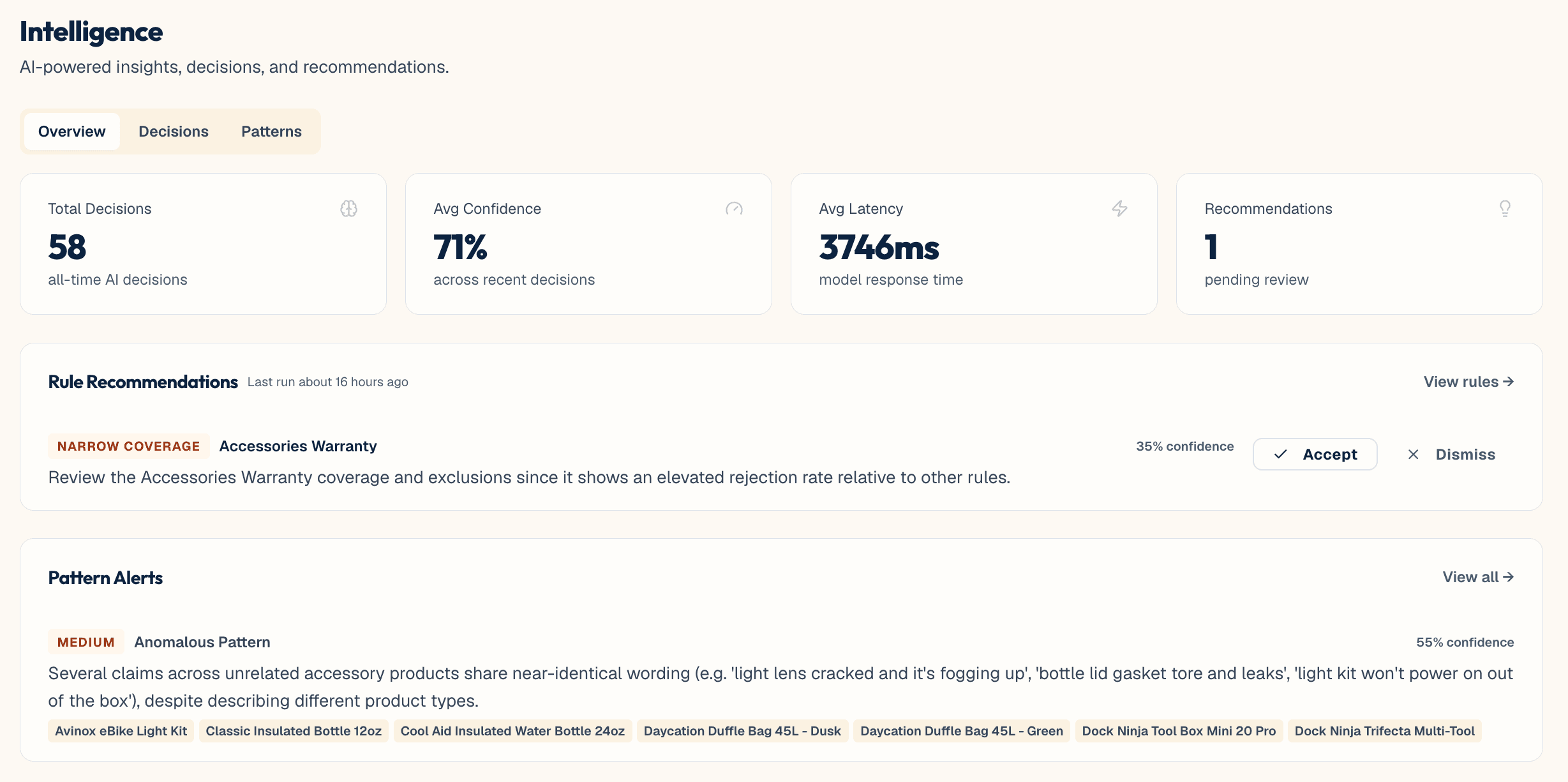
A separate screen (Dashboard → Intelligence), distinct from the per-claim AI suggestions that show up inside a claim. It has three views:
- Overview — a summary of AI activity.
- Decision log — a browsable record of every AI decision made, across all six decision types.
- Patterns — defect clusters and unusual spikes/anomalies. Rule recommendations can be accepted or rejected from here.
AI failures never block core workflows. Claim and registration operations succeed regardless of whether the AI layer is reachable — triage, assessment, and the rest degrade gracefully rather than holding up the underlying operation.